
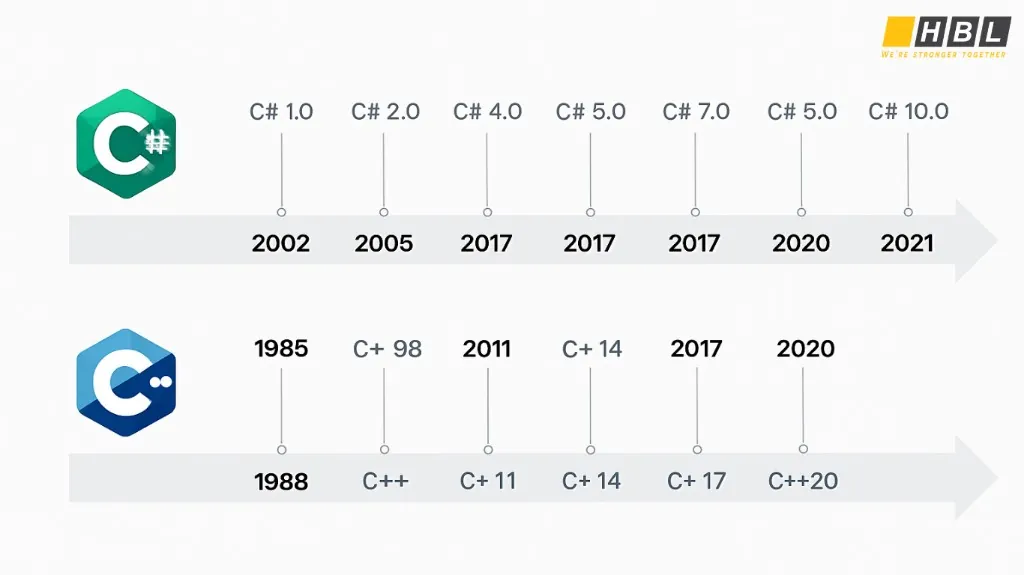
The Evolution of C#: From 1.0 to Modern Day
C# (pronounced “C-Sharp”) has been one of the most influential programming languages since its introduction by Microsoft in 2002. Let’s explore its remarkable journey.
The Birth of C# (2002)
C# was created by Anders Hejlsberg and his team at Microsoft as part of the .NET initiative. The language was designed to be:
- Simple: Easy to learn and use
- Modern: Object-oriented with strong typing
- Type-safe: Preventing common programming errors
- Powerful: Capable of building enterprise applications
C# 1.0 Features
The first version included:
- Classes and interfaces
- Properties and events
- Delegates and events
- Attributes
- Basic LINQ foundations
Major Milestones
C# 2.0 (2005) - Generics Revolution
Introduced generics, transforming how we write reusable code:
List<int> numbers = new List<int>();
Dictionary<string, User> users = new Dictionary<string, User>();
C# 3.0 (2007) - LINQ Era
Language Integrated Query changed data manipulation forever:
var adults = people
    .Where(p => p.Age >= 18)
    .OrderBy(p => p.Name)
    .Select(p => p.Name);
C# 5.0 (2012) - Async/Await
Simplified asynchronous programming:
public async Task<User> GetUserAsync(int id)
{
    return await _repository.GetByIdAsync(id);
}
C# 8.0 (2019) - Nullable Reference Types
Enhanced null safety:
string? nullableString = null;  // OK
string nonNullableString = null; // Warning!
C# 9.0 (2020) - Records
Introduced immutable data structures:
public record Person(string Name, int Age);
C# 10.0 (2021) - Global Usings & File-Scoped Namespaces
Reduced boilerplate code significantly.
C# 11.0 (2022) - Raw String Literals
Made working with JSON and multi-line strings easier:
var json = """
{
    "name": "Amir",
    "role": "Backend Developer"
}
""";
C# 12.0 (2023) - Primary Constructors
Simplified class declarations:
public class UserService(IUserRepository repository)
{
    public async Task<User> GetUser(int id)
        => await repository.GetByIdAsync(id);
}
Why C# Continues to Thrive
- Cross-Platform: With .NET Core/.NET 5+, C# runs on Windows, Linux, and macOS
- Performance: Continuous improvements make it competitive with C++
- Versatility: Web (ASP.NET Core), Desktop (WPF, MAUI), Mobile (Xamarin/MAUI), Games (Unity)
- Modern Features: Pattern matching, records, async streams
- Strong Ecosystem: NuGet packages, excellent tooling (Visual Studio, Rider)
The Future
C# continues to evolve with each release, focusing on:
- Developer productivity
- Performance improvements
- Cloud-native development
- AI and machine learning integration
Conclusion
From its humble beginnings in 2002 to becoming one of the world’s most loved programming languages, C# has proven its staying power. With Microsoft’s commitment to open-source and cross-platform development, C#‘s future looks brighter than ever.
Whether you’re building microservices, desktop applications, games, or mobile apps, C# provides the tools and performance you need to succeed.

Comments
Leave a comment